The Cloud That Never Falls
Hoffenheim's pillar-free membrane roof is German football's most quietly radical structure
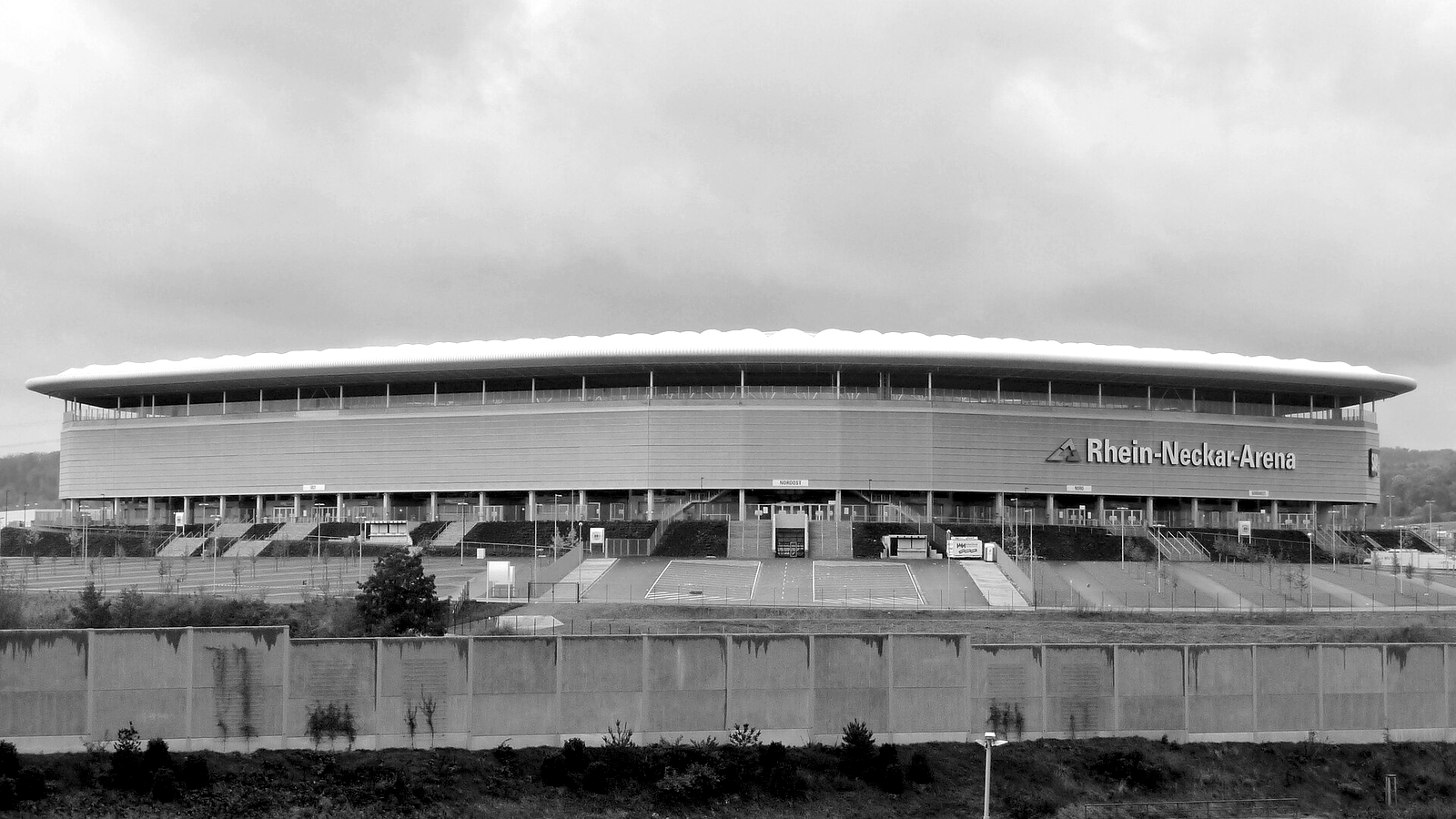
Sinsheim is a town of 3,600 people. It has a motorway running past its eastern edge, a large museum full of retired aircraft and vintage cars, and a football stadium that seats 30,150 spectators — the largest in the entire Rhine-Neckar metropolitan area. That disproportion is not an accident. It is a policy decision, encoded in concrete and tensioned membrane, and it shapes every institutional conversation TSG Hoffenheim has about itself.
The PreZero Arena — built in approximately 22 months on a plot directly adjacent to the A6 motorway and opposite the Auto & Technik Museum Sinsheim — was conceived to host top-flight football before Hoffenheim had earned the right to play it. Dietmar Hopp, the SAP co-founder whose patronage has defined the club's modern existence, funded a stadium whose capacity dwarfed the verein's entire municipality. In governance terms, this is unusual for German football: the 50+1 rule is designed precisely to prevent a single beneficial owner from treating a club as a vanity project, yet the statutes allow for grandfathered investment arrangements that make Hoffenheim's financial structure distinct within the DFL.
The architecture does not apologise for any of this. The defining feature of the arena is its membrane roof — a tensile canopy that encircles the bowl without a single support pillar interrupting the sightlines or the sky. Engineers describe it as a floating structure; the club's own materials call it a cloud. Both descriptions are technically defensible. The membrane admits diffuse light while deflecting rain, solving the perennial stadium-design problem of protecting spectators without plunging the pitch into shadow. It is the kind of engineering solution that tends to get named after the contractor rather than the architect, then quietly becomes the standard everyone else benchmarks against.
You build the stadium before the fanbase grows into it, and trust that the institution will fill the space it has claimed.
When Werder Bremen arrive on Saturday for Matchday 33, they will enter a stadium that is, in structural terms, more sophisticated than several built at ten times the cost and in twice the time. Andrej Kramarić, who has scored eight of his 14 Bundesliga goals for the season from Matchday 18 onwards, gives the fixture its headline number. But the fixture is also a governance audit of sorts: Hoffenheim need two wins from their remaining two games to record their highest-ever points total and secure a Champions League place, which would transform the club's broadcast-tier income and alter the financial calculus that underpins the whole operation.
What the PreZero Arena represents, then, is a particular hypothesis about football infrastructure: that you build the stadium before the fanbase grows into it, and trust that the institution will fill the space it has claimed. Bundesliga grounds built under more orthodox timelines — the incremental expansions at Dortmund, the phased reconstructions at Hamburg — follow a different logic, one rooted in Mitgliederversammlung consent and cautious capital allocation. Hoffenheim's approach was top-down, patron-funded, and fast. The 22-month construction schedule is the bluntest evidence of that. Whether the Champions League revenues materialise to sustain the model through the next cycle is a question the Aufsichtsrat will be examining long after the final whistle on Saturday.