German Design Anchors a Silesian Club Ground
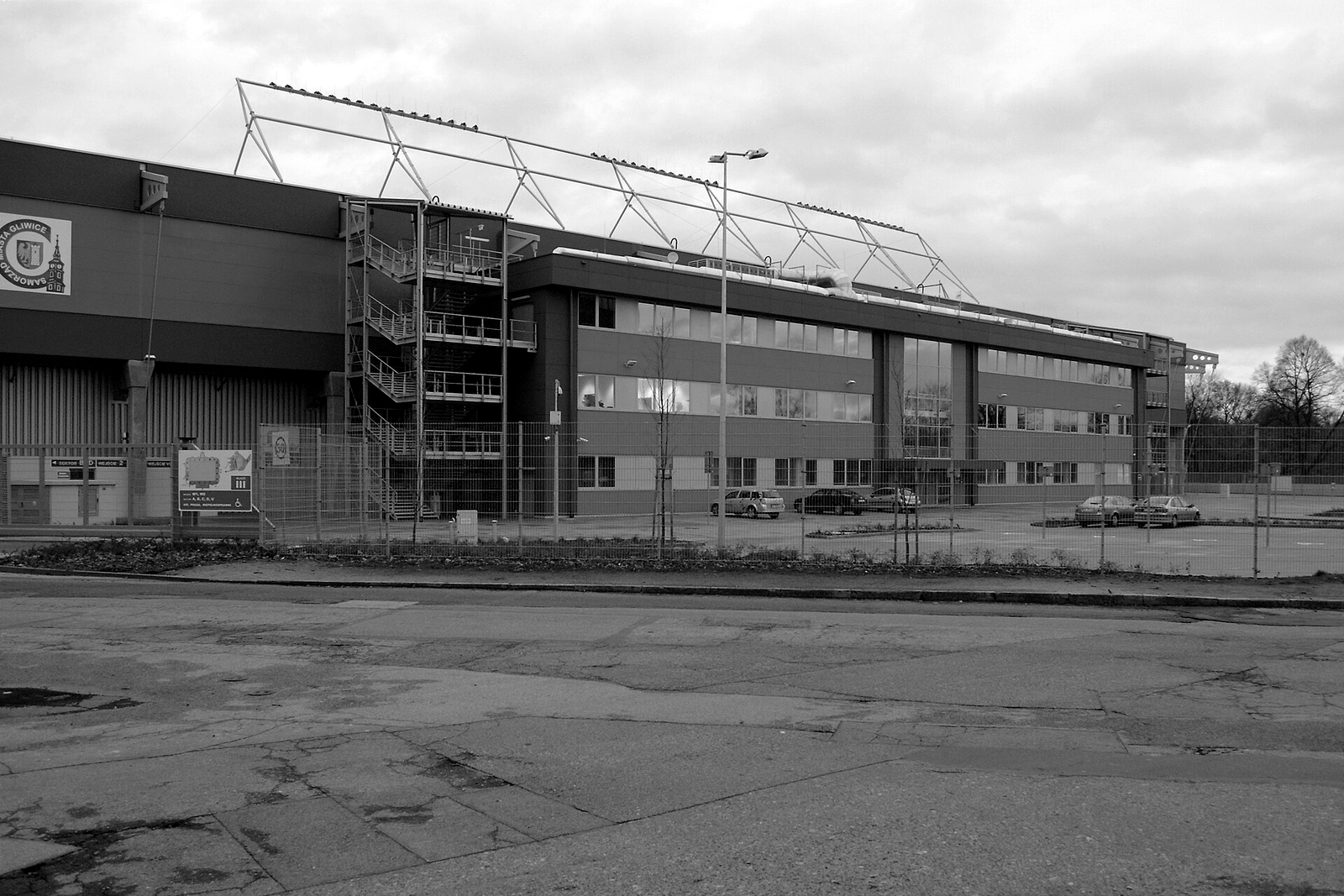
The Piotr Wieczorek Municipal Stadium in Gliwice stands as a deliberate architectural import, its single-tier concrete bowl and tensioned roof copied almost exactly from the Benteler-Arena in the German city of Paderborn some eight hundred kilometres to the west. The 2010-2011 reconstruction, carried out by the Bremen contractor Bremer AG, replaced a succession of earlier structures on the same plot and gave the club a modern, fully seated venue of just over ten thousand capacity at the moment when Piast began its climb through the divisions. In a region whose twentieth-century borders have shifted more than once, the decision to adopt a German model for a Polish municipal ground reads as one more layer in a long conversation between two neighbouring building traditions.
Gliwice itself occupies a stretch of Upper Silesia where industrial masonry and post-war housing blocks still define the skyline, and the stadium sits on the western edge of the city near the railway line that once carried coal and steel traffic across the old frontier. The site had hosted football since before 1939, when the ground belonged to a local German side; after the war the same plot passed to the newly founded Piast club, established by Polish families moved westward from territories annexed by the Soviet Union. That continuity of location makes the later choice of a German design firm feel less like an import and more like a return of certain engineering habits to a city whose fabric has always absorbed influences from both sides of the Oder.
The stadium’s footprint therefore carries two distinct historical registers at once. Its external elevations remain plain and functional, concrete walls punctuated only by the regular rhythm of access stairs and the long, low curve of the roof that shelters every seat without the need for internal pillars. Inside, the single continuous stand creates an intimate atmosphere even at modest attendances, a quality that suited a club whose supporters remember the years in the second and third tiers more vividly than the brief spell at the top of the Ekstraklasa in 2019.
On the morning of the fixture against Cracovia the concourse outside the main stand remains quiet, the surrounding streets lined with the low apartment blocks typical of Silesian districts that grew up around the mines. The design decision taken fifteen years ago continues to shape the daily life of the venue, allowing Piast to maintain a ground whose scale matches the club’s resources while still meeting league standards for covered seating and sightlines. In that sense the replicated Paderborn arena has become part of Gliwice’s own architectural inventory, another concrete expression of how the region negotiates its layered past through the buildings it elects to keep and to copy.